Listen.
A still workshop. A tiny leg twitch; a ticking brass hinge.
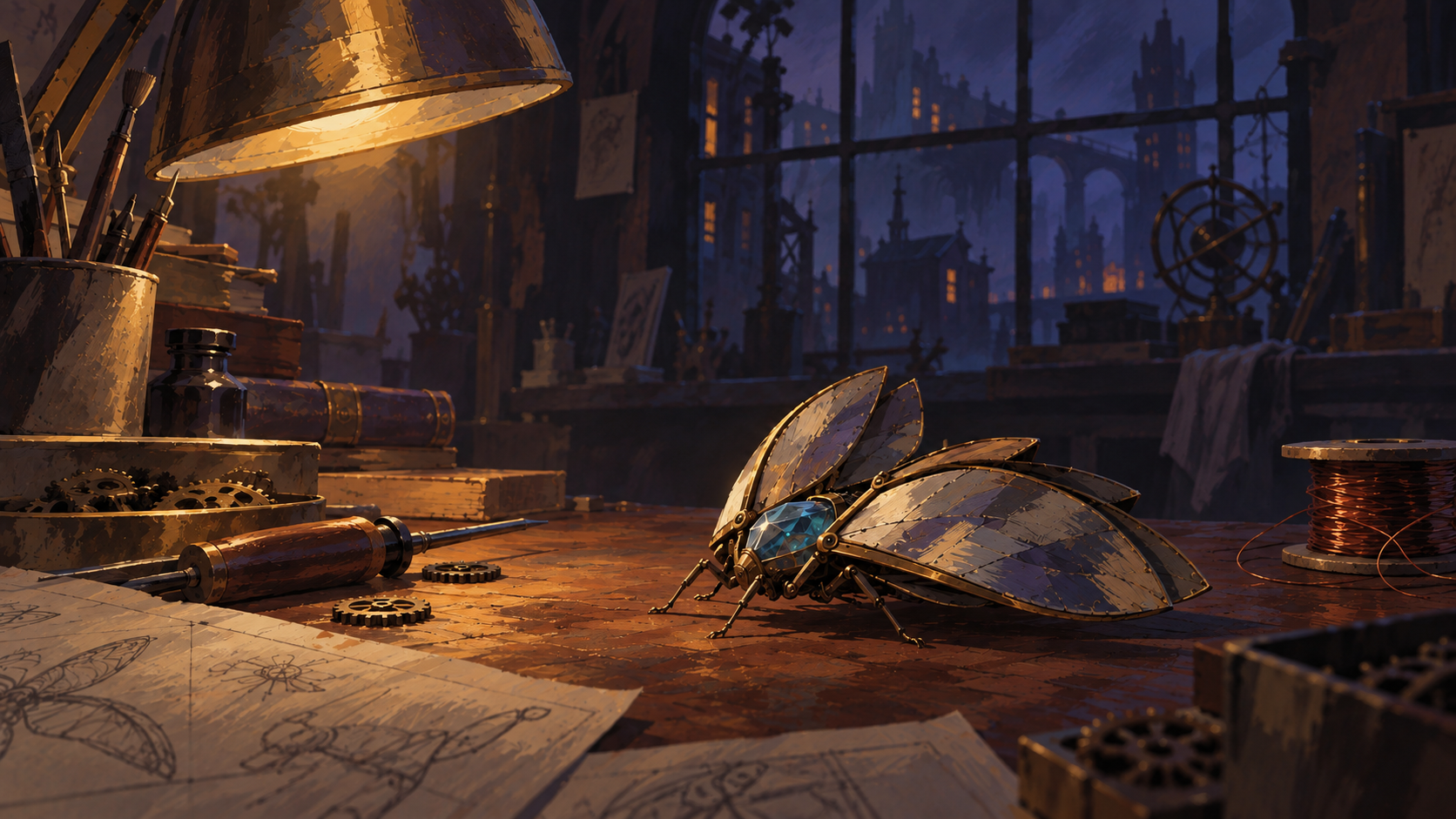
Loading SPARK
Brass. Crystal. A spark of life.
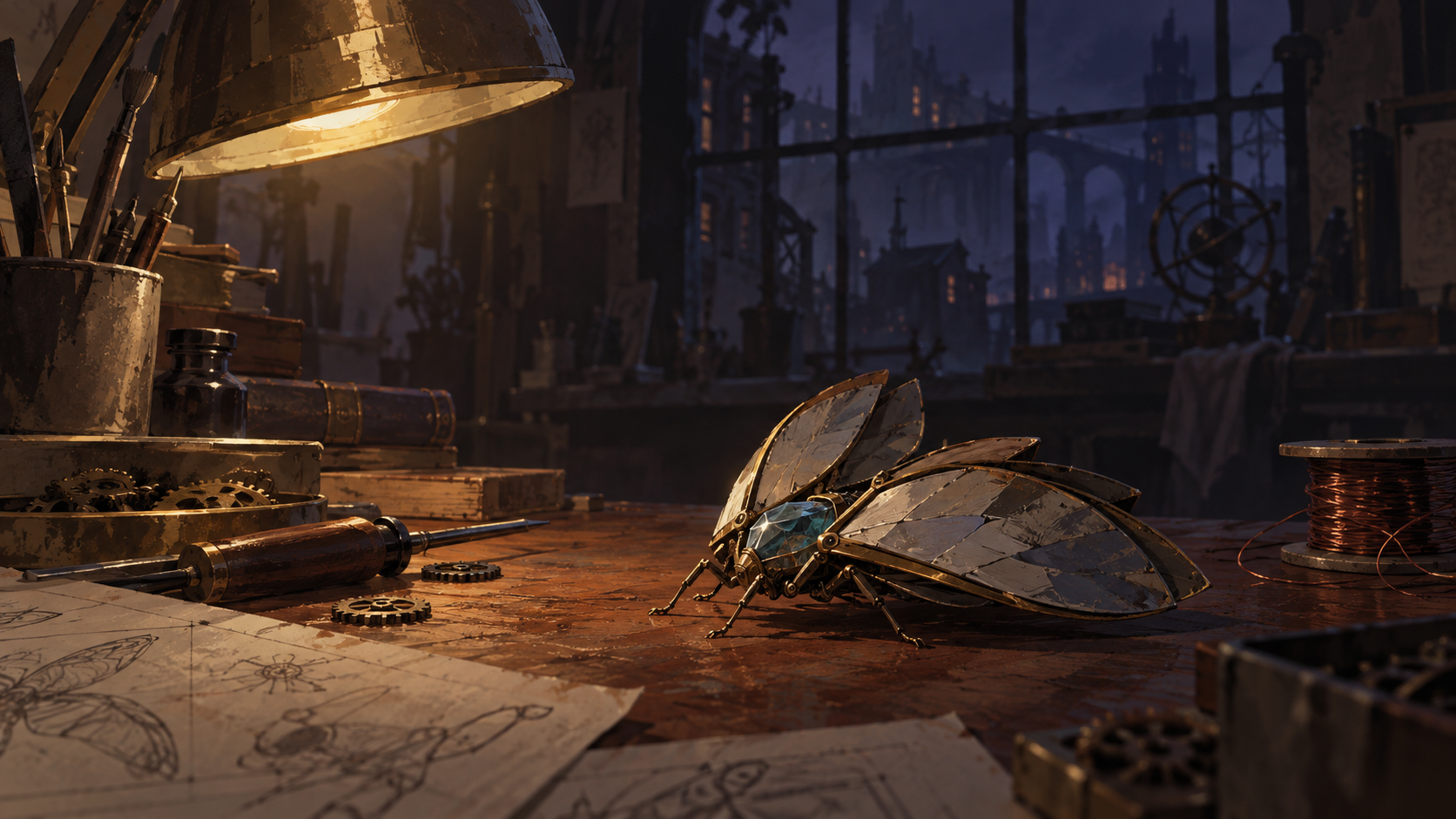
The revision replaces smooth shading with larger painted planes, broken brass highlights, and violet strokes in the wings. The quiet crystal leaves room for the ignition to change the whole image.
A still workshop. A tiny leg twitch; a ticking brass hinge.
The crystal kindles. Four wings unlock, one beat at a time.
A crouch, a sharp release, a drawn burst of cyan and gold.
The camera follows its rise. Sparks hang in the silence.
Fortiche describes a visual language of organic imperfection: painting and digital form, comic-book influence, and staging drawn from live-action cinema. Its listed production tools include Maya, Houdini, Nuke, Mari, and Guerilla.
Fortiche’s own technique notes ↗The studio’s Season 2 breakdowns separate design, layout, backgrounds, compositing, and 2D/3D effects. Those layers must share the same shape language; a glow filter alone cannot produce the look.
Fortiche’s making-of collection ↗Netflix’s interviews with the art and production designers show color and shape changing with the story. SPARK therefore saves its saturated cyan for the moment the creature comes alive.
Artist interviews & official reference gallery ↗Animation supervisor Alexis Wanneroy describes keyframed acting, carefully composed poses, painted textures, and hand-drawn effects over CG plates. The requested animation on twos is a target for this study, not a claim that all Arcane animation uses one cadence.
Interview with the animation supervisor ↗References were studied for technique. SPARK’s artwork is original; no Arcane footage, models, textures, or audio are used in the film.
The final cut preserves the painted scene and compact crystal, with original drawn spark accents held for two frames. The review below records the remaining differences from the target style.
Original AI-generated style frame, Kling 3.0 Pro motion and native sound, then an original vector effects layer and sound normalization. The added effects use 12 drawings per second over a 24-frame-per-second film. The creature’s generated motion remains smoother than true animation on twos. This is a film study with visible limitations, not an editable Blender scene or an identical Arcane match.
Production manifest ↗